

One Platform for your critical records
Data from every system gets a fingerprint, signature and timestamp, letting auditors, regulators and partners verify its integrity independently of Filedgr.
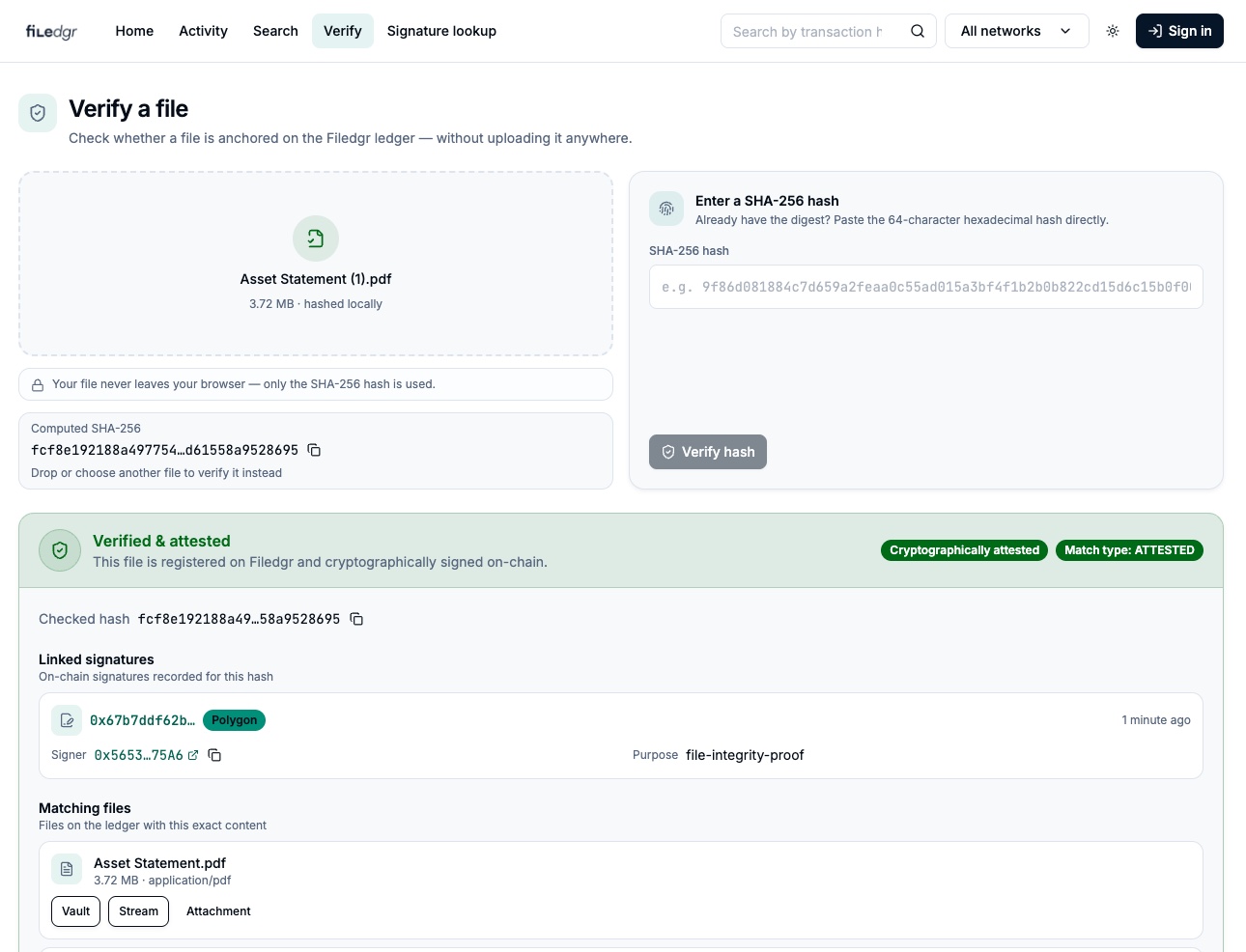
The problem
Who can confirm your data is the original once it’s been shared?
Your data is structured, versioned and working, inside your own stack. The trouble starts when a valuation, report or asset record goes to an auditor, investor, regulator or counterparty. At that point it’s a PDF, an export or an email attachment, and the recipient has to take your word that it’s the original and unchanged. Every review goes back to reconciling, re-requesting and re-checking.
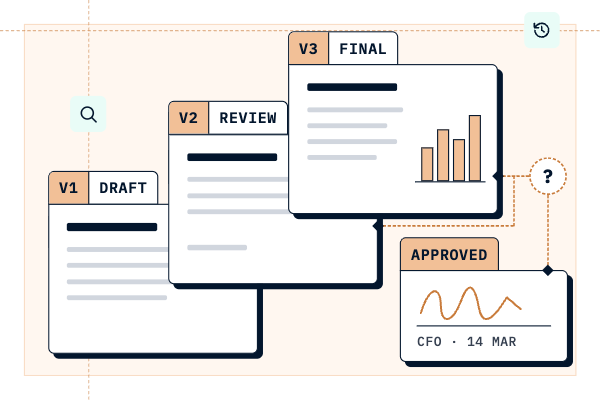
Auditor
Which version of the report was approved?
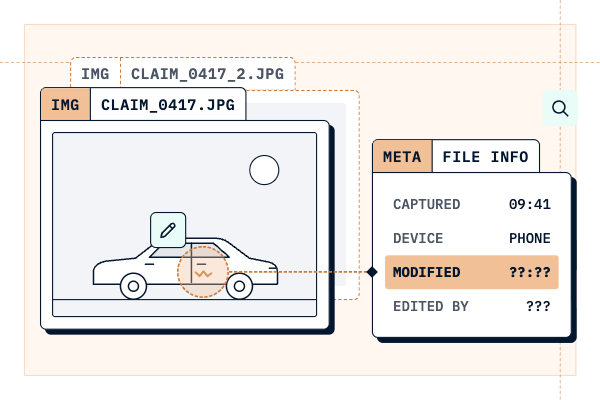
Insurer
Were the claim photos edited?
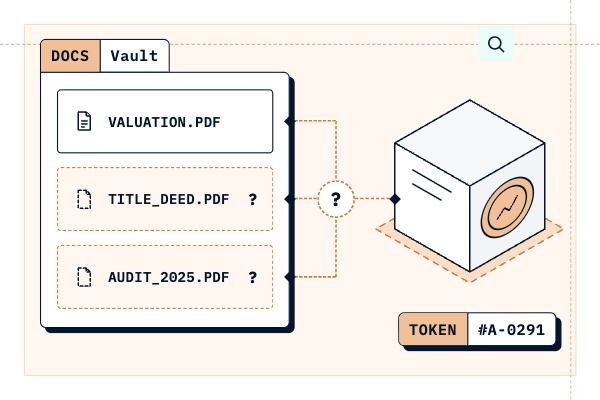
Investor
Which documents are behind the token?
What is Filedgr Platform?
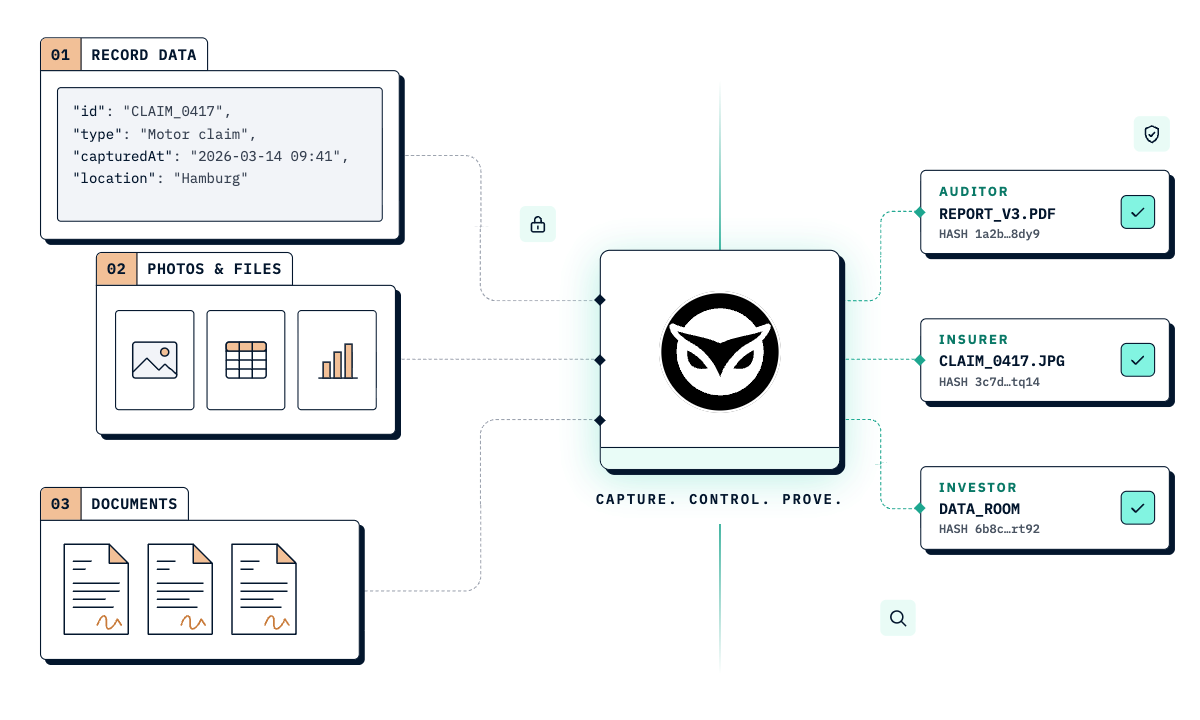
Filedgr Platform is a vault for critical business records. It collects data from many sources, gives each record a cryptographic fingerprint, signature and timestamp, and lets any authorized recipient check that the record is original and unchanged, independently of Filedgr. Compliance, insurance, tokenization and asset management teams use it for the records others need to trust.

How it works
How does Filedgr Platform make records tamper-evident?
1
Capture
Record it at the source
Files and data are hashed, signed and anchored in a Vault when they are captured. Origin and time are fixed. Data arrives via API, SDK, webhooks, template forms or the Filedgr Data Wallet, and each item is tied to whoever submitted it.
2
Control
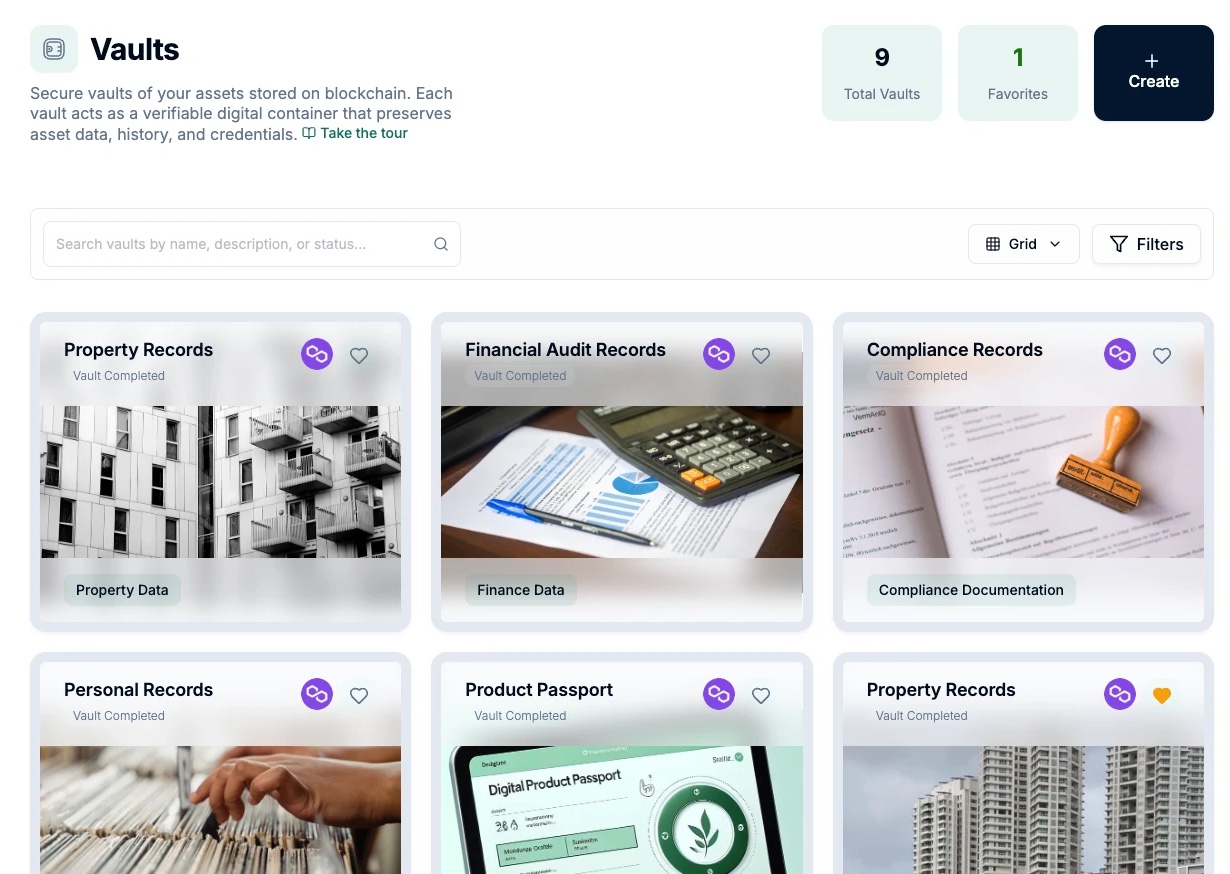
Share a proof package, not a folder
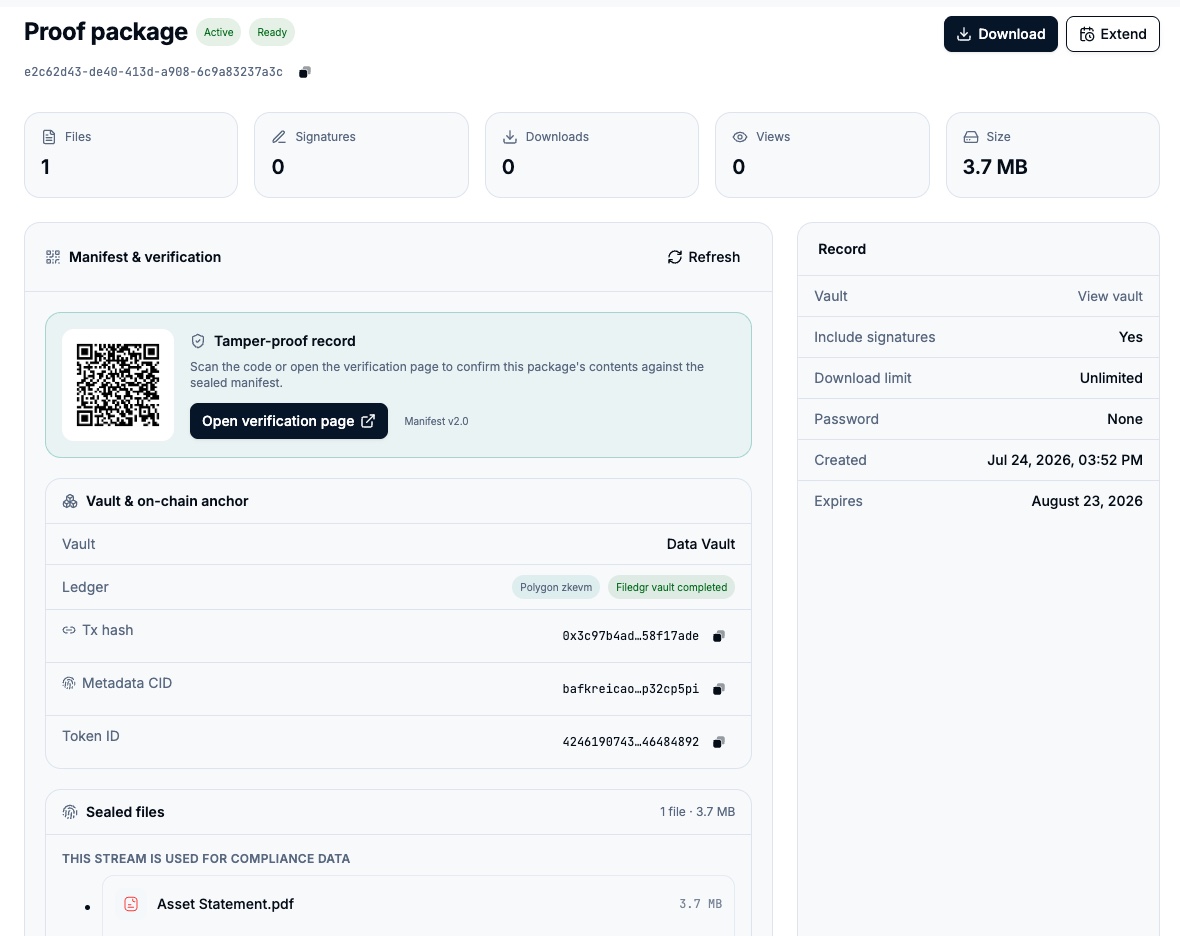
Bundle exactly the files a recipient needs, with signatures, download limits and an expiry date. Or grant access by role.
3
Prove
Let recipients verify it themselves
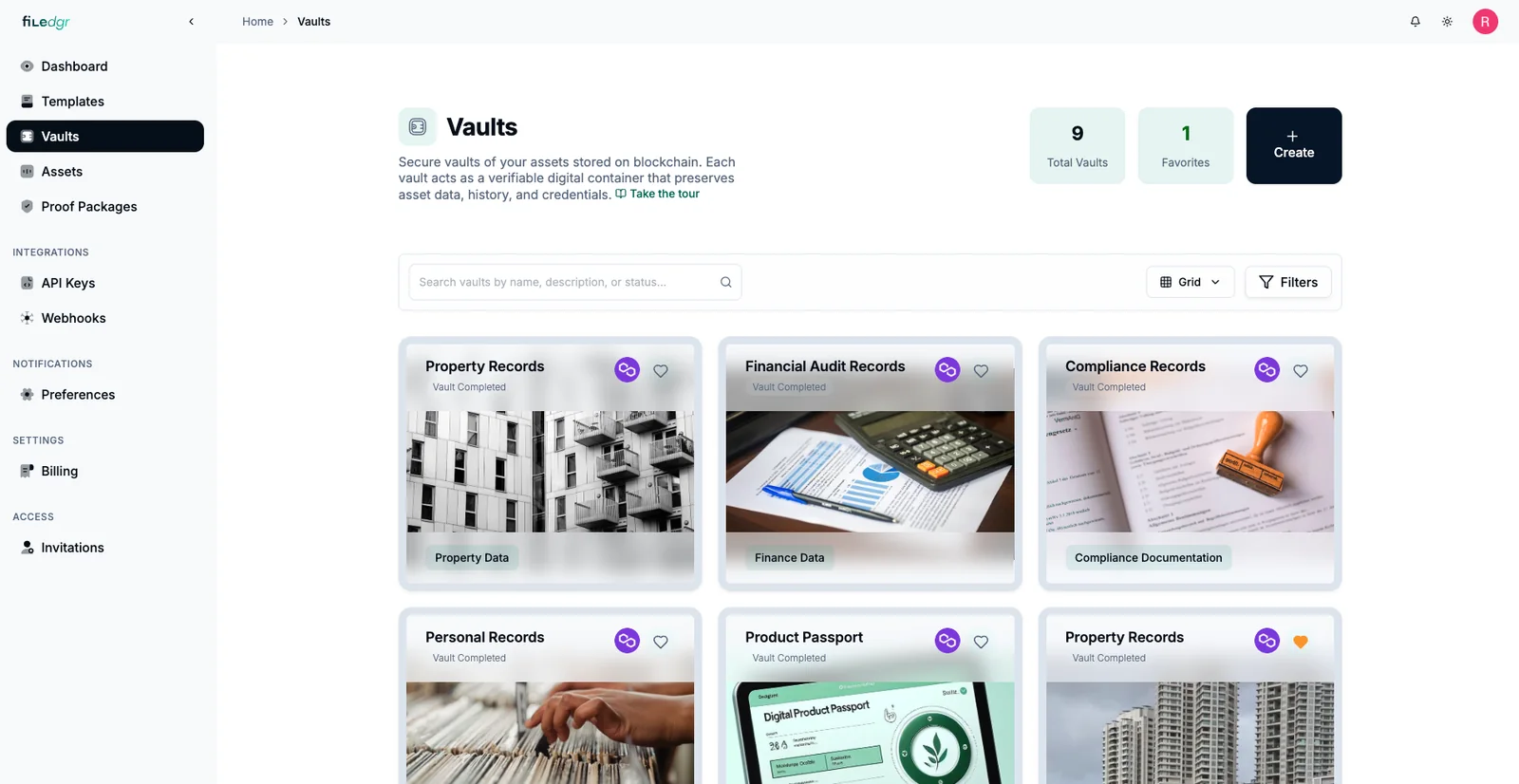
The recipient drops the file into the Filedgr explorer. It is hashed locally and checked against the on-chain record. Recipients see at once whether anything changed.
Use cases
How does Filedgr Platform help your team?
Different industries, one question: can you prove that a record is the one that was approved? Here is what changes when you can.
Compliance and audit: proof instead of screenshots
Today, every audit starts with collecting exports, screenshots and email threads to show which version was approved. With Filedgr Platform, reports, approvals and logs are sealed when they are created, and auditors check version, signer and date themselves.

Insurance: claims evidence that holds up
Today, photos, reports and invoices arrive by email or app, and nobody can tell whether a file was edited on the way. With Filedgr Platform, evidence is sealed at capture with time and origin, also in the field with the Filedgr Data Wallet. Adjusters, reinsurers and partners check its integrity themselves.

Tokenized assets: proof behind every token
Today, investors see the token on-chain, but the documents behind it sit in PDFs and data rooms. With Filedgr Platform, issuance documents, valuations and reports are anchored when they are issued and kept together in one Vault per asset, so investors and custodians verify them without asking the issuer.
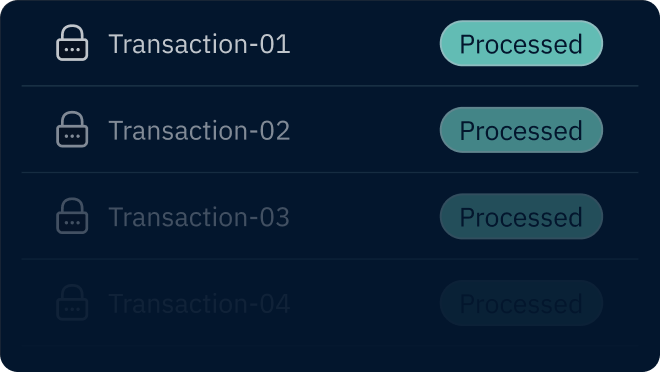
Funds and asset management: one version that counts
Today, an investor asks for the NAV statement approved on June 30, and two versions sit in two email threads. With Filedgr Platform, NAV reports and valuation data are signed and timestamped at approval, so investors, administrators and auditors know which version counts.
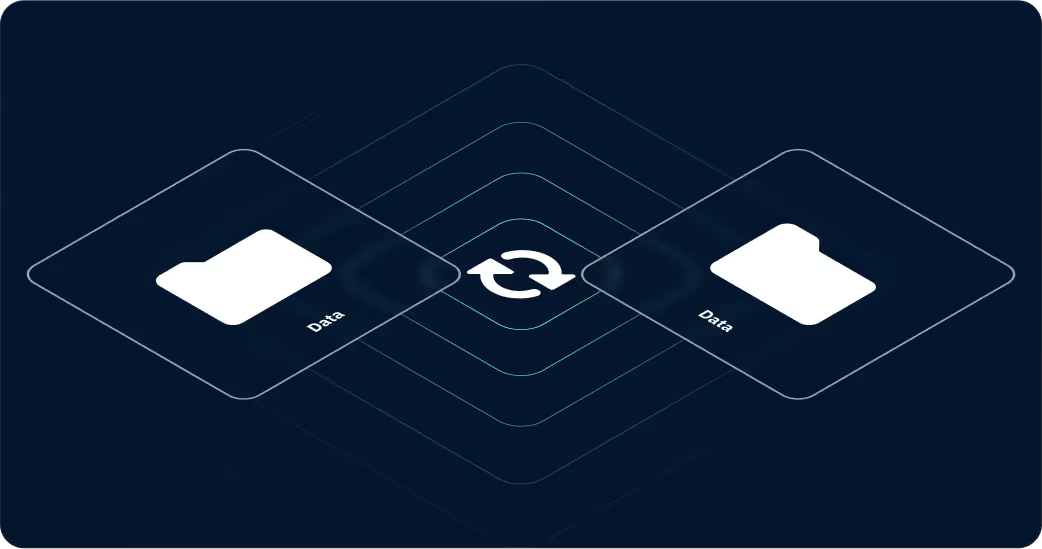
Why Filedgr Platform
What makes Filedgr Platform different?
Any source, a history that survives handovers, and proof that works without Filedgr.
Any source
Which sources can feed a Vault?
Any system that produces a file or a data point: ERP, accounting and fund systems via API and SDK, document systems and data rooms via webhooks, template forms for teams without code, and the Filedgr Data Wallet in the field. All streams land in one Vault with one record history.
View API docsHandovers
What happens when people or providers change?
Nothing is lost. Records and their proof history belong to the Vault, not to the person or provider who created them. The owner revokes and grants roles, and every signature stays tied to who signed and when.
Independent proof
How do auditors verify without Filedgr?
In the public Filedgr Explorer, or fully offline with the downloadable signature file and standard cryptographic tools. If even one byte has changed, the check fails.
Verify a recordComparison
How is Filedgr Platform different from the software you already use?
E-signature tools such as DocuSign prove who signed. Data rooms control who sees a file. Oracles and verifiable databases bring data on-chain. Filedgr Platform proves that a record is original and unchanged from the moment it is captured, whichever system it came from.
| Compared on | E-signature (e.g. DocuSign) | Data room or DMS | Oracle or verifiable database | Filedgr Platform |
|---|---|---|---|---|
| What it proves | Who signed a document, and when | Who uploaded or opened a file | A value or query result used on-chain | A record is original, signed and unchanged since capture |
| What it covers | Documents sent for signature | Files uploaded to it | One data feed or one database | Data and documents from any system, form or field capture |
| Who can verify | Anyone with the signed PDF, through the provider's certificate | Users with a login | Smart contracts and their users | Anyone with the record, via Explorer or offline |
| After staff or provider change | Depends on account administration | Depends on folder hygiene | Not its job | Full history stays in the Vault |
The categories are complementary: a contract signed in DocuSign can be captured in a Vault, and a Vault record can be the verified source an oracle later reports.
Security and controls
Which controls protect the data in a Vault?
Integrity
Fingerprints
SHA-256 hash and IPFS content address for every file.
Identity
Signatures
ECDSA (secp256k1) signatures; keys derived from the user's login, no seed phrase to manage.
Access
Permissioned Vaults
Files served only to authenticated users with the right role.
Traceability
Access log
Every upload, signature and permission change is recorded with time and user.
Assurance
Certifications
In progress.
Product family
Works with Data Wallet and AssetID
Field teams capture straight into a Vault with the Filedgr Data Wallet. Filedgr AssetID runs capture, control and proof end to end for financial and tokenized assets.
Filedgr supports compliance evidence, review and reporting workflows. It does not certify compliance, decide legal ownership or replace your auditor.
FAQ
What is Filedgr Platform?
Filedgr Platform is verification infrastructure for critical business records. It collects documents and data from many sources, gives each record a SHA-256 fingerprint, a digital signature and a blockchain-anchored timestamp, and keeps its full history. Authorized recipients such as auditors, regulators or partners can then check that a record is original and unchanged, without relying on Filedgr.
Can an auditor verify a record without a Filedgr account?
Yes. The auditor opens the record in the public Filedgr Explorer and sees the signer, the timestamp and the blockchain transaction. For a fully independent check, they download the signature file and verify the hash and signature offline with standard cryptographic tools. If a single byte of the record has changed, the check fails.
Which data sources can I connect to a Vault?
Any system that produces a file or a data point. ERP, accounting, fund and document systems connect through the REST API, SDK or webhooks. Teams without code use template forms in the Filedgr Web App, and field staff capture photos, video, audio and scans with the Filedgr Data Wallet. All sources land in one Vault with one record history.
Does Filedgr Platform replace DocuSign or our document management system?
No. Filedgr Platform works alongside them. E-signature tools such as DocuSign record who signed a document and when, and document management systems control who can open a file. Filedgr Platform adds proof that a record is original and unchanged since capture, for documents and data from any system. A contract signed in DocuSign can be captured in a Vault and verified alongside your other records.
What happens to our records when an employee or service provider changes?
The records and their proof history stay in the Vault. Access is granted by role, so the owner revokes the departing person's role and assigns it to the successor. Every earlier signature remains tied to the person who signed and the time of signing, so the history continues without gaps.
Is our data stored on the blockchain?
No. Only the record's fingerprint and signature are anchored on a public blockchain, together with a timestamp. The content itself stays off-chain in the Vault's storage, and permissioned Vaults serve files only to authenticated users with the right role. The anchor proves when a record existed in its exact form without revealing what it contains.
Does Filedgr Platform make us compliant?
No tool can make a company compliant. Filedgr Platform supports compliance evidence, review and reporting workflows by making records tamper-evident and their history verifiable. It does not certify compliance, determine legal ownership or replace your auditor. Its ISO 27001 and SOC 2 audits are in progress.
Last updated November 4, 2026
Get started today
Stay ahead of audits and evolving regulations with verified integrity.
Get in touch to learn more.
