What Is Data Integrity in Tokenization? Why On-Chain Assets Need Verifiable Off-Chain Proof
Tokenized assets are on-chain. The data behind them usually isn't verifiable. Here's why that's the defining risk in real-world asset tokenization.

The token is recorded on-chain with precision; the data that gives it value usually is not verifiable. Data integrity closes that gap, so anyone can check where a valuation came from, when it existed, and whether it changed. Fund managers, their auditors and secondary-market buyers all test that data and where it cannot be verified independently, a due-diligence delay or a valuation dispute follows. This article is part of our guide to verifiable asset data for tokenized assets.
What is data integrity in tokenization?
Data integrity in tokenization is the property that a third party can rely on the data behind a token without relying on the party that produced it. It has three parts.
Provenance: who created the record, when, and on what basis — attributable, not merely asserted.
Independent verification: the record can be checked by a token holder, auditor or regulator without access to the platform that holds it.
Append-only history: later changes add new, attributed entries rather than overwriting the old ones, so the record's history is inspectable.
This standard applies to every material record behind the asset: valuations, compliance certifications, income distributions, ownership changes and risk factors. It is distinct from storage. Most platforms already store these records well. Integrity is about the two things storage does not provide on its own, showing who is responsible for a record, and showing that it has not silently changed.
Why does off-chain data decide whether a tokenized asset holds up?
On a distributed ledger, the token entry is tamper-evident. The valuation, income record or compliance certificate it points to typically is not: it sits in a spreadsheet, a PDF or an internal database that can be changed without leaving a trace. Tokenization inherits the integrity of that off-chain layer, not the integrity of the chain. On-chain precision beside off-chain assertion is the structural contradiction at the center of most real-world-asset projects.
This is not only a vendor's framing. In its October 2024 report on the financial-stability implications of tokenisation, the Financial Stability Board identifies reliance on third parties including "oracles" that collect and store data for DLT platforms and "asset price and quality" risk from opacity as core vulnerabilities, and notes that many claimed benefits of tokenisation remain unproven (FSB, 2024). When an asset is tokenized, its underlying data is referenced in investment documentation and secondary-market pricing and is examined by counterparties sophisticated enough to ask whether the data meets the same standard as the technology representing it. Where it does not, the gap becomes a liability rather than a footnote.
Which rules actually govern the data behind a tokenized asset?
Here the common online answer is wrong, and getting it right changes what a team builds. It is often said that "MiCA requires verifiable records for tokenized assets." For the assets in this article tokenized funds and securities that is not the governing regime. MiCA (Regulation (EU) 2023/1114) explicitly excludes crypto-assets that qualify as financial instruments under MiFID II (Article 2(4)); ESMA's December 2024 guidelines make the classification an asset-by-asset test (ESMA, 2024). A tokenized fund unit or security is a financial instrument, so its data obligations flow from MiFID II, the fund frameworks (AIFMD/UCITS) and, for market infrastructure, the DLT Pilot Regime — not from MiCA. MiCA governs the other categories: asset-referenced tokens, e-money tokens and other crypto-assets.
For tokenized funds specifically, AIFMD requires "appropriate and consistent" valuation procedures with documented methodologies for each asset class (Article 19). AIFMD II (Directive (EU) 2024/927) strengthens governance over the valuation chain and applies from 16 April 2026; its enhanced supervisory-reporting requirements the granular data capture and identifiers such as ISINs and MICs apply from 16 April 2027, a year later. The verification principle across all of these is the same: every valuation, attribute and pricing input should be defensible and independently checkable, not merely asserted by the manager's internal systems. (This is regulatory context, not legal advice; classification is a case-by-case exercise for your own counsel.)
| Tokenized asset | Primary regime for the data | What MiCA does here |
|---|---|---|
| Fund unit (AIF / UCITS) | AIFMD / UCITS + MiFID II | Excluded — financial instrument |
| Tokenized security (equity, bond) | MiFID II (+ DLT Pilot Regime) | Excluded — financial instrument |
| Asset-referenced / e-money token | MiCA (ART / EMT rules) | Applies |
| Other crypto-asset (utility, etc.) | MiCA (other crypto-assets) | Applies |
How do you make off-chain asset data verifiable?
The fix is not more documentation, and not "putting it on the blockchain" the asset is already on-chain. It is attestation: proof that specific data existed in a specific form at a specific moment, attributed to a specific identity. Three mechanisms produce it.
1. Sign — attribute the record. Each critical data event is signed with the responsible party's cryptographic key. The signature is tied to the record's content, so any later change to that content invalidates it. Under eIDAS, signatures come in simple, advanced and qualified levels; the higher levels add identity assurance, and the integrity check is the same arithmetic at every level (eIDAS, Articles 25–26).
2. Timestamp — prove when it existed. An independent timestamp from a timestamping authority under RFC 3161, or by anchoring the record's hash in a blockchain transaction binds the content to a point in time that the platform cannot move afterward. This turns "we recorded this on that date" into "this exact content existed at that time, checkable by anyone."
3. Keep an append-only history. Once attested, a record is not silently altered. A change becomes a new, attributed, timestamped entry; the prior version stays in the history. Changes still happen they are simply intentional, attributed and preserved rather than hidden.
Each mechanism answers only part of the question, and it is worth being precise about the limits. A hash shows whether content changed, not what changed or whether it was accurate. A signature shows who committed to the content, not whether they were authorized to approve it. A timestamp shows when the record existed, not when the underlying event occurred. Together they make a tamper-evident record not an "immutable" or "legally proven" one.
What does the gap look like in practice?
A fund administrator signs a month-end NAV report. The record is hashed (a SHA-256 value beginning 3f9a…), the administrator's key signs that hash, and the hash and signature are anchored in a ledger transaction at 17:42 UTC. Six months later an investor's auditor receives a copy and hashes it. If the result begins 3f9a… and the signature verifies, the copy is the report that was signed at 17:42 UTC confirmed without access to the fund's systems. If it begins with anything else, the copy differs from the signed original, and the conversation moves from negotiation to a question with an answer.
The same logic maps to the four points where unverifiable data usually costs a platform:
| Where the data fails | What triggers the question | The mechanism that answers it |
|---|---|---|
| Valuation dispute | A holder challenges a NAV or secondary-market price | Recorded hash + signer + timestamp of the valuation as issued |
| Due diligence stalls | An investor asks to verify provenance without platform access | Independently checkable signature + append-only history |
| Regulatory review | A supervisor asks for the record behind a reported figure | Attributed, timestamped record matching the reported version |
| Secondary-market pricing | A buyer cannot confirm the asset data | Third-party-verifiable record, no issuer trust required |
Verify it yourself
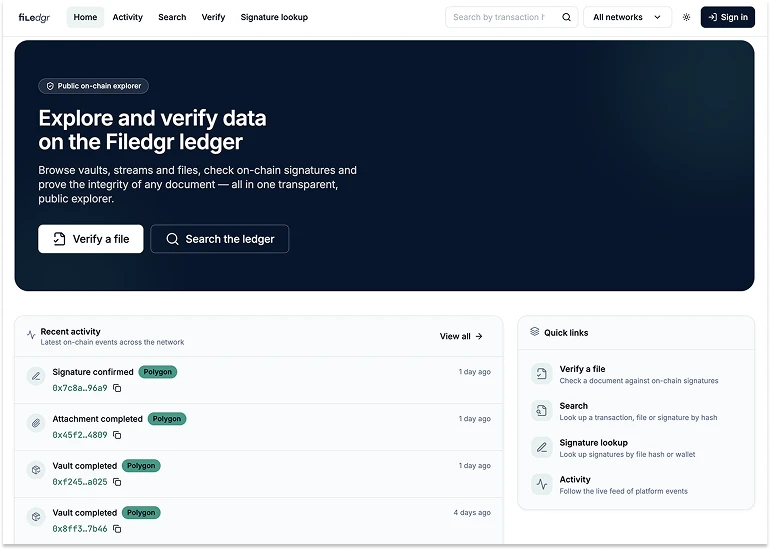
1. Open the Explorer. Go to Filedgr Explorer and open a record below.
2. Check the three things that make a record tamper-evident.
- Signature — a valid signature shows the record was committed to by the holder of a specific key, and that the content hasn't changed since. A broken or missing signature means the copy differs from what was signed.
- Transaction & timestamp — the anchored blockchain transaction shows the record's hash existed at a specific time that the issuer cannot move afterward.
- Record history — the append-only history shows whether anything was added or changed later, and when.
3. Read the result. Signature valid + transaction present = this is the record that was signed, at that time. Anything else = the copy in front of you is not the original, and that's your signal to ask for it.
What this does not tell you: whether the underlying value is accurate, whether the signer was authorized to approve it, or what a token means legally. The Explorer proves the record's integrity, attribution and history not the truth of its contents.
Those questions still belong to your own review; the difference is that you're now asking them about a record everyone agrees is the original.
Try it on the example, then ask the same of any tokenized asset you're evaluating: can I check the data behind it without access to the platform that produced it?
What do teams get wrong about tokenized-asset data?
Treating the ledger as the proof. The ledger entry is tamper-evident; the data it references is not. Integrity has to be captured at the off-chain record, not assumed from the chain.
Checking file metadata instead of content. Creation and modification dates in file properties can be edited in seconds and are evidence of nothing. Only a recorded hash compared against the file shows whether content changed.
Calling records "immutable." Files can still be changed; what attestation guarantees is that a change becomes visible. "Tamper-evident" is accurate; "immutable" and "proof of truth" are not.
Assuming MiCA is the data rulebook. For tokenized funds and securities it is not (see above). Building a data programme against the wrong regime means answering the wrong reviewer.
Where Filedgr fits
Filedgr is verification infrastructure for critical asset data. It adds the attestation layer to records you already produce: when a valuation, document or corporate action is captured, it is signed by the responsible party, timestamped and anchored, and kept with an append-only history and its asset context (Capture. Control. Prove.). Access to the content stays permissioned, while the integrity information can be checked independently — since June 2026, anyone can verify a record's signature and blockchain transaction in the public Filedgr Explorer without a Filedgr account and without seeing the file itself. When a record has to leave your systems, Proof Packages carry the hash, signature and timestamp with it.
Filedgr AssetID applies this to a tokenized asset as a whole: a persistent reference that links the on-chain asset to an independently verifiable off-chain record, so token holders, auditors and secondary-market participants can check the data behind it rather than trust an assertion. A documented example is VIRIDIS's issuance of the VIA Security on AssetID. AssetID does not calculate or audit NAV, does not judge whether a valuation is accurate, and does not determine a token's legal status it makes the record's integrity, attribution and history demonstrable so those questions can be asked of a record everyone agrees is the original.
Explore AssetID and book your demo.
Frequently asked questions
Isn't a blockchain record already immutable?
The ledger entry is tamper-evident, but the data behind it usually is not. Valuations, compliance certificates and asset attributes typically sit in spreadsheets, PDFs and internal databases that can be changed without a trace. Tokenization inherits the integrity of that off-chain layer, so the off-chain record needs its own attestation.
Does MiCA apply to a tokenized fund, or does something else govern the data behind it?
For a tokenized fund unit or security, MiCA does not apply — Article 2(4) excludes crypto-assets that are financial instruments under MiFID II. The data obligations flow from MiFID II and the fund frameworks (AIFMD/UCITS), with the DLT Pilot Regime for market infrastructure. MiCA governs asset-referenced tokens, e-money tokens and other crypto-assets. Classification is case-by-case; confirm yours with counsel.
How do we prove the data behind our tokenized fund hasn't changed, without giving investors access to our systems?
Record a cryptographic hash of each valuation or document, sign it with the responsible party's key, and anchor it with an independent timestamp. An auditor can then hash the copy they hold and check it against the recorded hash and signature — a match confirms it is unchanged, without any access to your platform.
Does AIFMD apply to tokenized assets or only to funds?
AIFMD applies to alternative investment funds and their managers. Tokenize a fund and its valuation methodology and governance fall under it directly (Article 19), with AIFMD II applying from 16 April 2026 and enhanced reporting from 16 April 2027. Tokenized individual assets such as real estate or loans sit under other frameworks, but the verification principle is the same.
Sources
Get started today
Stay ahead of audits and evolving regulations with verified integrity.
Get in touch to learn more.