Why Regulated Finance Has a Data Integrity Problem
Most regulated institutions store data securely. Few can prove it. Learn why data attestation is becoming the new compliance standard in regulated finance.

Why Regulated Finance Has a Data Integrity Problem It Cannot Ignore
Every regulated institution stores data. Most of them cannot prove it.
That distinction between storing data and proving it, is where audit failures happen, where disputes become expensive, and where regulatory reviews turn into multi-week reconciliation exercises. It is also where Filedgr operates.
This article explains what verifiable data infrastructure means, why it matters specifically for fund managers, compliance teams, and tokenization platforms, and what the gap between storage and proof costs organizations that haven't closed it yet.
The Storage Problem Nobody Talks About
Ask any compliance officer whether their firm stores data securely. The answer is always yes.
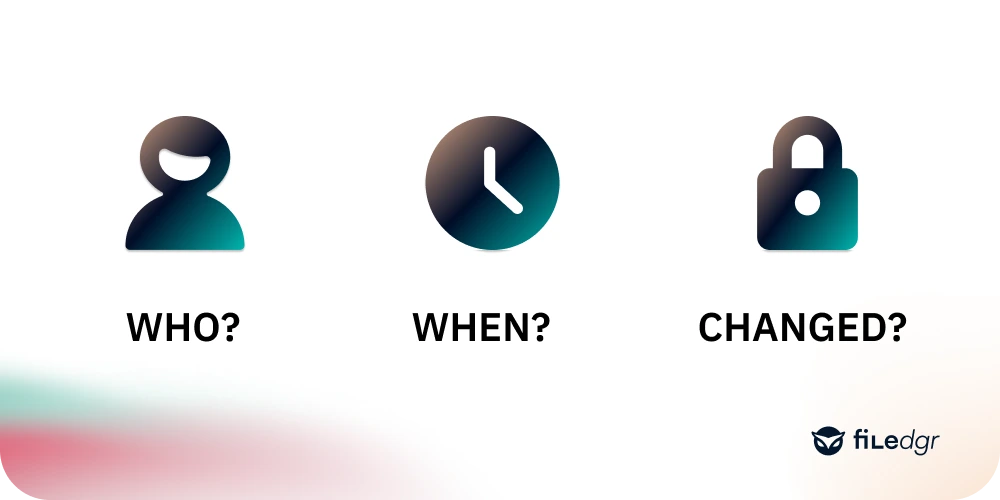
Ask them whether they can reconstruct a fully verifiable, tamper-evident history of a specific data record from fourteen months ago: who created it, who approved it, whether it was altered and the answer becomes significantly more complicated.
This is not a failure of intent. It is a failure of infrastructure.
Enterprise data systems like ERP platforms, cloud databases, document management tools are built to store and retrieve data efficiently. They were not built to prove it. The timestamps in these systems are internal. The access logs are managed by the same system you're asking to validate the data. The version histories are controlled by whoever administers the platform.
In an audit, this means you are presenting what your own system says about your own data. That is not independent verification. That is circular trust and regulators are increasingly aware of the difference.
What This Costs in Practice
The consequences of unprovable data are not theoretical. They show up in three specific situations:
Audits:
Compliance teams spend weeks preparing for major regulatory audits with a significant portion of that time spent manually reconstructing data histories that should be instantly accessible. When records span multiple systems, time zones, and counterparties, reconciliation becomes a project in itself.
Disputes:
When a counterparty contests a valuation, a NAV figure, or a contractual data point, the burden of proof falls on whoever is making the claim. Without an immutable, timestamped record attributing the data to a specific identity at a specific moment, disputes default to "he said, she said" and resolution depends on legal process rather than evidence.
Regulatory reviews:
MiCA, CSRD, and EUDR each demand increasing transparency around data provenance. The implicit requirement behind all three frameworks is the same: demonstrate, don't claim. Show the regulator not just that the data exists, but that it has not been altered and that the appropriate parties approved it. Organizations that cannot meet this standard operationally are building regulatory risk into their infrastructure.
The Three Questions Your Data Cannot Answer
Verifiable data infrastructure is not about adding a blockchain stamp to a PDF. It is about ensuring that every critical data record in a regulated workflow can answer three specific questions under scrutiny:
1. Who created this?
Not which system. Which identity means a specific person or authorized entity has signed and submitted this record. In regulated markets, accountability is personal. Systems do not sign off on valuations. People do.
2. When did it exist in this exact form?
Not when it was uploaded. Not when a system logged it. When it was cryptographically timestamped as existing in its precise current state verifiable by any party, independently of the system that created it.
3. Has it changed since?
Not "has anything been flagged as changed." Has any bit of the data been altered and if so, is there a new verifiable record of that change, attributed to an identity, with its own timestamp?
If your current infrastructure cannot answer all three questions for every critical data point asset valuations, NAV reports, compliance documentation, counterparty approvals you have a verification gap. And the cost of that gap compounds every quarter.
Why This Matters More Now Than Three Years Ago
Three structural shifts have moved verifiable data infrastructure from a nice-to-have to an operational requirement.
Tokenization of real-world assets:
As private credit, real estate, and fund units move on-chain, the underlying data that supports those assets becomes permanently visible. A tokenized NAV report does not exist in a closed internal system. It exists on a public ledger, scrutinized by every counterparty and investor with access. A claim about data integrity is not sufficient in this environment. Cryptographic proof is the baseline expectation.
According to Boston Consulting Group, the market for tokenized assets is projected to reach $16 trillion by 2030. The data infrastructure supporting those assets must match the verifiability standards of the assets themselves.
AI in regulated decision-making:
Financial institutions are deploying AI for portfolio analysis, compliance screening, and regulatory reporting. Each of these applications creates a new class of liability: if the AI made a decision based on data that was incomplete, altered, or incorrectly attributed, who is responsible? Without a verifiable record of the data state at the moment it was used, that question cannot be answered and regulators will ask it.
Tightening regulatory standards:
MiCA requires verifiable records for crypto-asset issuance and trading data. CSRD mandates auditable evidence chains for sustainability reporting. EUDR requires documented proof of supply chain compliance. Each framework implicitly demands the same capability: data that is not just stored but provable. Organizations that build their compliance posture on documents and internal controls will face increasing friction as these standards are enforced.
What Verifiable Data Infrastructure Looks Like
The term "data attestation" is used in different ways. For the purposes of regulated finance, it means three things working together:
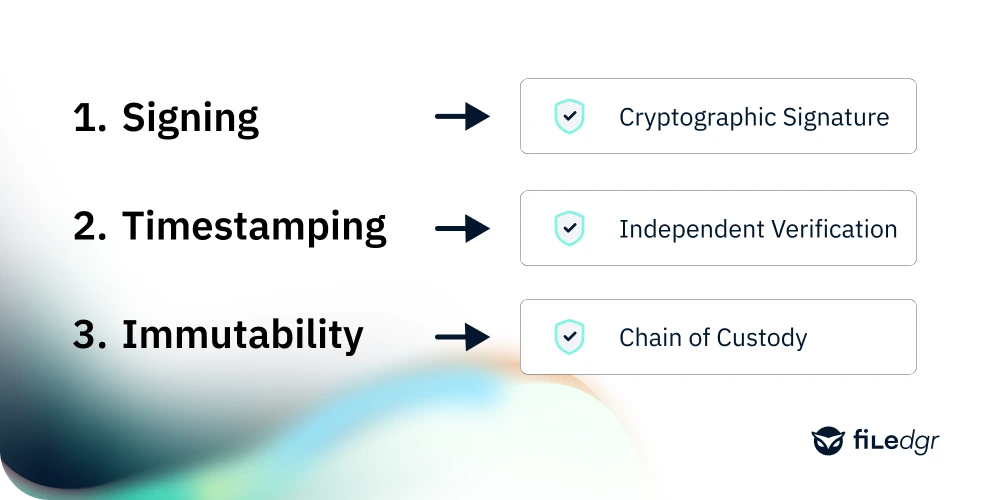
Signing: Every critical data record is attributed to a specific identity a person, role, or authorized entity through a cryptographic signature. This is not a username in a system. It is a verifiable credential that cannot be retrospectively reassigned or denied.
Timestamping: The moment a record is created or modified, it receives an independent timestamp and anchored outside the system that manages the record. This timestamp is verifiable by any party, at any point in the future, without requiring access to the originating system.
Immutability: Once attested, a record cannot be silently altered. Any modification creates a new verifiable event in the record's history, attributed to an identity and timestamped. The full chain of custody is preserved automatically.
When these three elements are in place across a regulated workflow, the audit trail is not something you build retroactively. It is a byproduct of normal operations.
What Changes Operationally
The organizations using Filedgr report three consistent operational shifts.
Audit preparation time drops materially. When every critical record already carries its own verifiable history, the manual reconciliation phase is eliminated or significantly reduced. Evidence does not need to be reconstructed it is already structured and accessible.
Dispute resolution becomes faster. When a counterparty challenges a data point, you do not begin an evidence-gathering process. You present a timestamped, signed, independently verifiable record. The burden of proof is already met.
Regulatory confidence increases. Compliance officers can demonstrate to regulators not just that data exists, but that it meets the evidentiary standard for authenticity and integrity. This is increasingly the difference between a review that closes quickly and one that escalates.
Who This Is Relevant For
Fund managers operating under AIFMD, UCITS, or MiCA requirements who need verifiable NAV records, valuation histories, and counterparty approval chains.
Tokenization platforms issuing real-world assets who need the underlying data to meet the same verifiability standard as the on-chain assets themselves.
Compliance and risk teams in financial institutions who are responsible for producing audit-ready evidence under CSRD, EUDR, or internal governance frameworks.
Auditors and legal counsel who need to verify the authenticity of records provided by counterparties without requiring full system access.
The Infrastructure Decision
Storage solved one problem: where does the data live?
The next infrastructure problem is harder and more consequential: can you prove what the data is, where it came from, and that it has not changed?
For most regulated institutions, the answer is currently no. Not because they lack data but because their infrastructure was built for a different question.
Filedgr is built for the new question.
It does not replace existing systems. It does not require blockchain expertise or migration projects. It adds a verification layer to the data workflows you already have only ensuring that every critical record is signed, timestamped, and independently verifiable.
The organizations that build this capability now will not just be more compliant. They will be faster in audits, more credible in disputes, and better positioned for the regulatory and market standards that are already forming.
Before your next audit, before the next regulatory review see what verifiable data infrastructure actually looks like in practice.
The demonstration takes 20 minutes. No migration required.
Book a demo with our data integrity experts.
Filedgr is a Verification Infrastructure for regulated industries — Making Asset Data Verifiable and Audit-ready

Kim Dinse
Kim is a B2B marketing strategist with a background in business economics and over five years of experience. As CMO of Filedgr, she drives brand growth around verifiable data infrastructure, with a focus on tokenized assets and financial data.
Get started today
Stay ahead of audits and evolving regulations with verified integrity.
Get in touch to learn more.